.png)

For many eCommerce business owners, the day begins with a typical problem-solving process: advertising budgets are growing, but customer acquisition costs are barely covered by the average order value; loyal ones choose global marketplaces like Amazon and Temu simply because checkout takes two seconds; and so on. Ultimately, today's leaders aren't those with the largest product selection, but those who have adapted their IT architecture to anticipate customer needs before they even realize them. That's why we decided to dedicate this article to how to transform the technologies you use into your primary growth driver.
Key Drivers Behind eCommerce Digital Innovation
The market is oversaturated with offers, while customer attention is becoming the most scarce resource, and to retain it, businesses are forced to resort to eCommerce digital transformation.
Growing expectations of online shoppers
If your interface forces users to think about what to do next, and search fails to provide relevant results within half a second, you're unlikely to gain customer loyalty. Today, customer expectations are growing faster than the legacy systems’ capabilities, so this is a main pain point for eCommerce business owners. The solution lies in a thorough frontend modernization and server optimization.
Direct-to-consumer models gaining momentum
The direct-to-consumer model allows manufacturers to bypass intermediaries and interact directly with buyers. At the same time, the transition to D2C requires businesses to build their own powerful IT infrastructure capable of processing thousands of orders, setting up personalized loyalty programs, providing data security in accordance with regulatory requirements like GDPR, and more.
Efficient logistics and fulfillment networks
Innovative supply chain management technologies allow companies to predict demand and distribute products to warehouses before a customer clicks the buy button. Digital fulfillment also helps businesses minimize picking errors and automate returns. Finally, integrating warehouse systems with marketplace services in real time eliminates operational chaos.
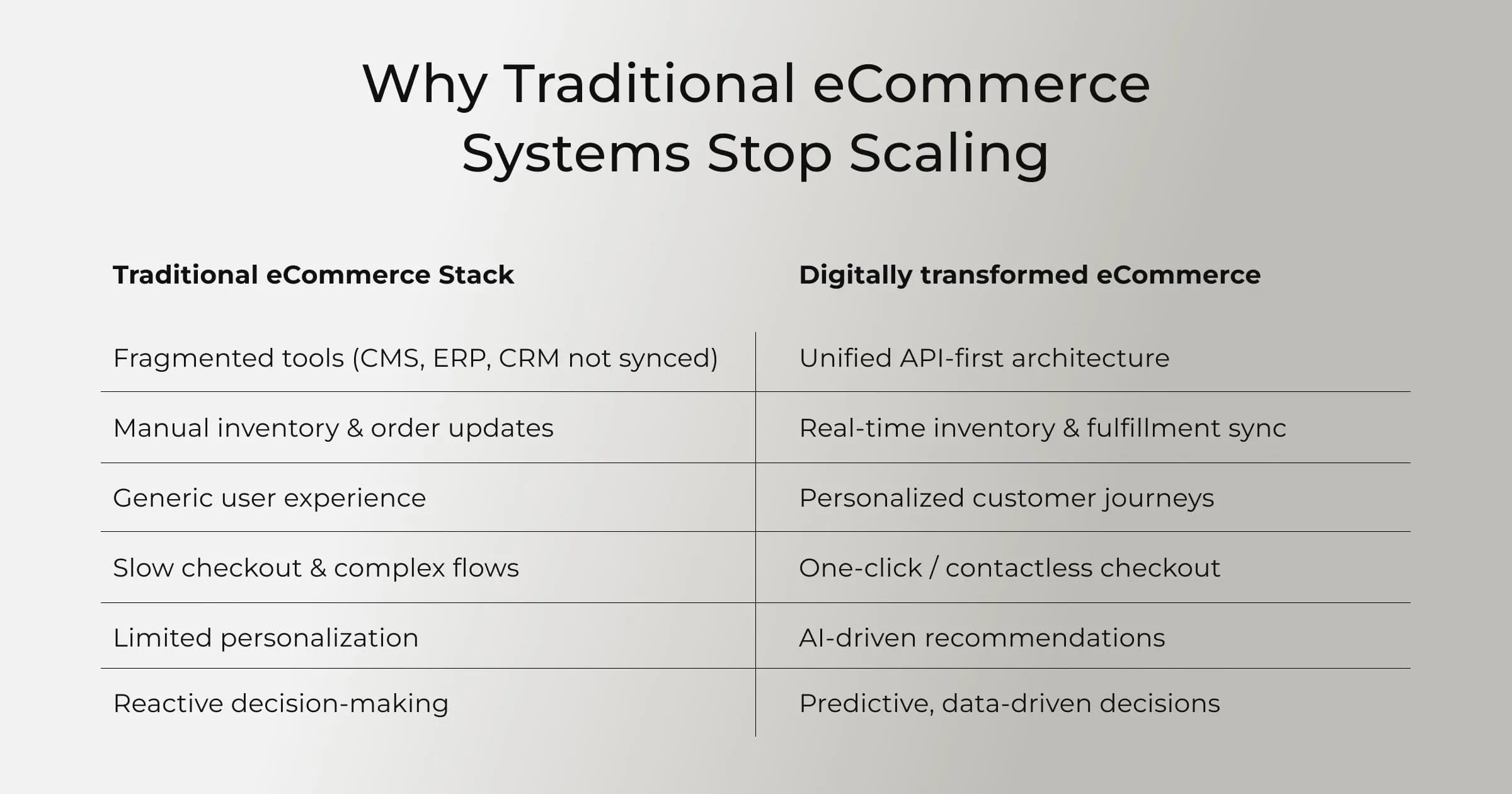
Digital transformation shifts eCommerce from reactive selling to proactive customer experience.
Ways Digital Innovation Is Changing eCommerce
Innovations effectively create new points of contact with the brand, in particular, the following ones.
Using augmented reality for smarter purchases
Augmented reality solves the problem of the inability to touch a product online, reducing returns and thereby increasing customer confidence in their choice. Furthermore, integrating AR modules into mobile apps shortens the decision-making cycle for purchasing complex or expensive items.
AI-powered product recommendations
Artificial intelligence can transform predefined "also bought" algorithms into deep predictive analytics that take into account hundreds of parameters, including previous browsing history and wishlist likes, behavioral patterns, and even the current weather in the user's region. Thus, AI solves the problem of low average order value by offering customers exactly what they need at the moment, which ultimately positively impacts their lifetime value and results in a 15-30% uplift in conversion rates.
Seamless contactless shopping experiences
This includes contactless payments at brick-and-mortar retail locations, as well as the implementation of biometric solutions, Apple Pay, Google Pay, and crypto payments online. In particular, since abandoned carts are often caused by complex registration forms or a poor payment experience, innovations can connect customers' online profiles with their physical presence in stores, creating a seamless sales funnel.
Tailored suggestions for each customer
Hyper-personalization allows customers to see a customized version of the website's homepage, complete with relevant promotions and discounts. For retailers, this is a way to stand out from the crowd of giant marketplaces by offering value that can't be realized through price gouging.
Deeper understanding of buyer behavior
Digital innovations give brands the ability to see what a customer purchased and why they made that decision (or why they left or abandoned their cart). Heatmaps, session analysis, and big data also come to the rescue here – all of which are aimed at identifying bottlenecks in the sales funnel. This enables reducing marketing budgets and freeing up resources for channels and functions that generate real revenue instead of wasted traffic.

Alex Lozitsky
Co-founder and CEO
Emerging Trends in eCommerce Technology
Innovations today are primarily aimed at making the system autonomous and natural for interaction with end users.
Workflow automation
Many eCommerce industry players face a loss of control over warehouse inventory, order statuses, and price updates. Digital transformation, achieved through the integration of ERP and warehouse systems, eliminates human error. At the same time, automating product procurement when critical inventory levels are reached, as well as generating consignment notes, saves companies hundreds of man-hours.
Conversational AI and chatbots
Conversational AI understands context and customer intonation, and is fully capable of replacing human consultants, answering both simple questions like “Where is my order?” and those that require big data analytics, such as assistance with item selection. And all this is achieved without increasing call center staff.
Interactive and immersive product displays
3D product models and 360° video demonstrations address the issue of consumer mismatch, which is the main cause of returns. Specifically, interactive displays allow users to interact with the product virtually, thereby increasing the time spent on the site and emotional engagement, which influences impulse purchases.
Integration of social media shopping
Integrating a product catalog into Instagram, TikTok, or Pinterest allows customers to make purchases directly from their news feed. Specifically, this implies creating a unified omnichannel core that manages sales across all social networks, minimizing the risk of overselling and ensuring brand integrity.
Flexible payment options like BNPL
Integrating the Buy Now, Pay Later model significantly increases the average order value, especially in the electronics and fashion categories. For the buyer, this reduces the financial burden, while for the store, it's an opportunity to close a deal with a customer who hasn't yet decided on a product.
Progressive web apps for faster experiences
Progressive web apps are a technology that combines the best of a website and a mobile app. They are available even with poor internet connections, can send push notifications, and allow users to make purchases without downloading software from app stores. In general, PWAs reduce data usage by up to 80% and increase mobile sessions, as seen in cases like Starbucks.
Strategies to Implement Digital Innovation in Your Store
To ensure innovations don't become mere show-offs but generate real profit, you need to follow a clear implementation plan.
In-depth tech audit and bottleneck identification
Before implementing any innovations, it's essential to conduct a performance audit using the Google Lighthouse methodology. If your Largest Contentful Paint metric exceeds 2.5 seconds, any marketing innovations will be ineffective. In general, to identify bottlenecks, you should use heatmaps like Hotjar and Microsoft Clarity, and perform end-to-end analytics to find points where users are churning. Your ultimate goal is to build a prioritized list (i.e., backlog), with tasks with the highest revenue impact and lowest cost at the top.
Transition to an API-first architecture
If your store is a monolith where the frontend and backend are interconnected, any innovation will cost five times more due to the need to rewrite the core. To upgrade such an architecture, you can choose the Strangler Fig Pattern, which involves gradually wrapping the old system with new microservices. From a technical perspective, this is achieved by moving the frontend to modern frameworks and connecting backend services via API gateways.
Following an MVP principle and iterative hypothesis testing
We don't recommend investing significant budgets in innovations like AR fitting rooms for the entire catalog at once. It's much better to launch an AR module for just five top products and compare metrics: has the return rate decreased and the conversion rate increased in this group compared to the control group. In general, you'll need to A/B test each new feature, and, if it doesn't yield at least a 5% increase in average order value in the first month, your hypothesis will definitely require refinement.
Building a data-driven core
Innovation is useless if it doesn't generate training data. That's why your strategy should include creating a unified customer profile. Specifically, all data from the new chatbot, digital showroom (like the one we’ve implemented for an online vintage store), and mobile app should be fed into a single customer data platform. This will allow AI to build predictive models and, in particular, to promptly detect when a customer will switch to a competitor within several weeks.
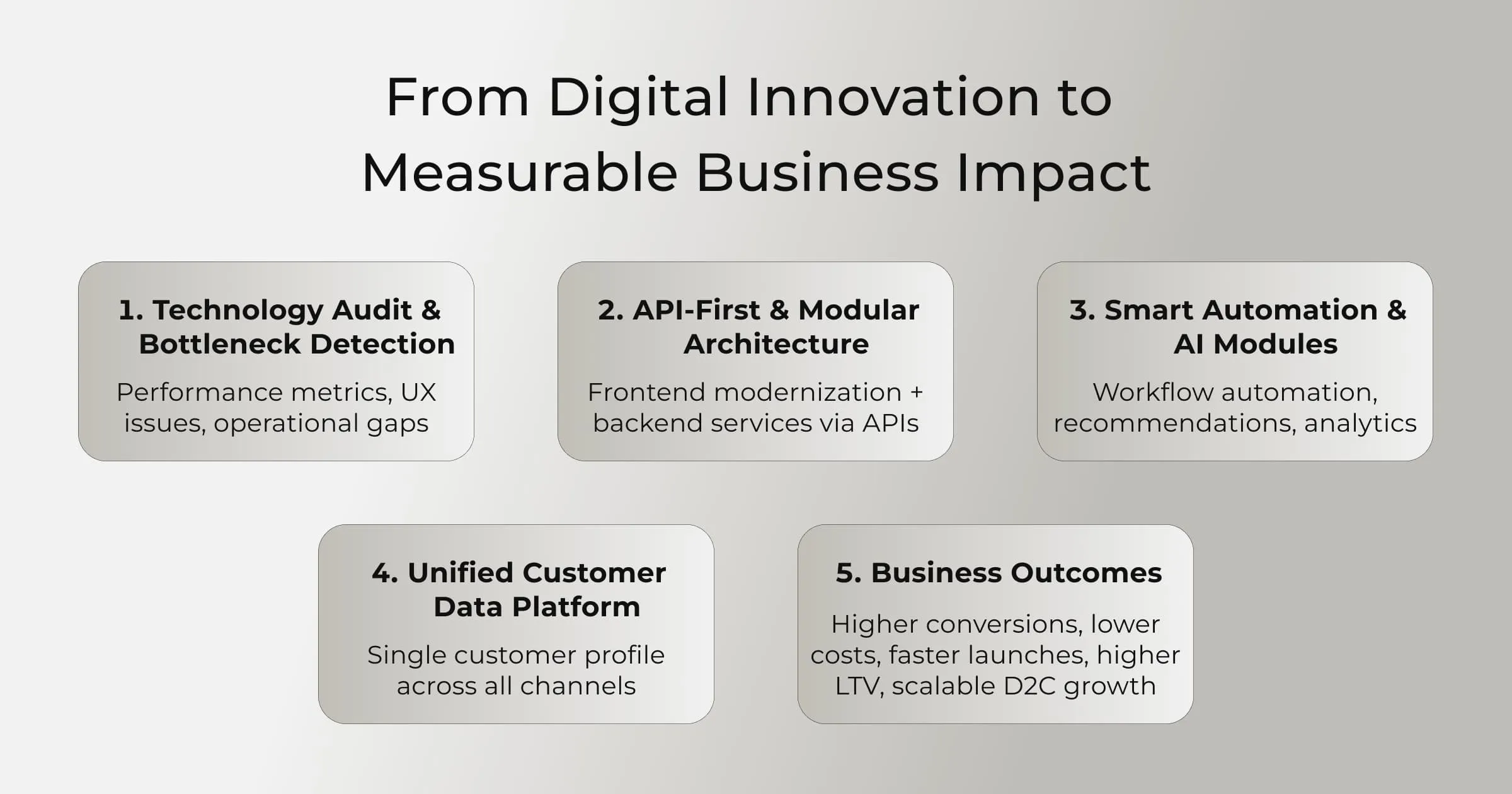
Digital transformation delivers value only when technology is directly tied to revenue metrics.
Long-Term Effects of Digital Transformation on eCommerce
e-Commerce digital transformation allows a brand to become resilient to market fluctuations and become a leader.
Growth in direct-to-consumer revenue
Owning the relationship with the customer means owning the data. In a cookieless world, this is the only way to maintain targeting precision. This way, a D2C model allows brands to fully reclaim the margins previously taken by retailers and distributors. In particular, implementing last-mile delivery and direct contact with each customer opens the opportunity to build deep loyalty.
Advanced personalization via Big Data
The longer a company uses Big Data algorithms, the more accurate its forecasts become. Over time, the system begins to predict customer lifecycles, creating a mind-reading effect, thereby maximizing LTV.
Here’s the experience our partner recently shared with us:
"We’re moving away from the “one interface for everyone” approach toward Generative UI – a model where AI doesn’t just generate content, but dynamically shapes the interface itself based on the user’s request and context. In 2026, personalization is no longer just a “Recommended for you” section – it’s a living UI that adapts to interaction history, behavior, intent, and even mood: rearranging blocks, offers, and the logic of content display in real time.In practice, this means personalized product feeds, individualized promotions, and an interface that adjusts to each person." – Denys Studennikov, COO at Turum-burum.
Visualizing products with AR
The large-scale implementation of augmented reality changes consumer culture in the long term. Shoppers are becoming accustomed to the fact that the risk of error when purchasing online is minimal, meaning the eCommerce sector will achieve a significant reduction in return rates.
Continuous optimization of processes
Digital transformation initiates a cycle of continuous improvement: since modern brands' IT infrastructures allow for hundreds of simultaneous A/B tests, they no longer require the involvement of top management to solve micro-tasks.
Adoption of new payment solutions
The long-term effect of implementing solutions such as cryptocurrency support and biometrics is the expansion of sales geography. Thus, by eliminating currency and transaction barriers, local brands can more quickly become global.
Mobile shopping expansion
Mobile commerce is becoming a primary sales channel, which is why the emergence of super apps that combine shopping with social media, banking, and lifestyle services is expected. Many brands are also actively investing in mobile UX and PWAs, betting that desktop sales will eventually become a niche segment.
Evolution of B2B eCommerce
Wholesale purchasing is becoming as convenient as ordering a pizza. Long-term contracts, personalized price lists, and automatic reorders are moving to self-service portals, significantly reducing sales department costs and eliminating errors in complex supply chains. Overall, digital portals reduce the cost-to-serve by up to 40% through automation of routine reorders.
Would you like to get all of these benefits for your business? Contact us, and we'll get started on your project!
Alex Lozitsky
Co-founder and CEO