.png)

.webp)
Is your business seeing sales grow by 30-40%, but your team just can't keep up with the extra work? This often means you are constantly putting out fires with customers, which can lead to missed deadlines and lost contracts.
Let's look at why this happens and how you can set up better processes to grow your revenue by working with a white-label development partner.
Why Agencies Hit a Delivery Ceiling Before They Hit a Growth Ceiling
To bring in new leads more often, owners of growing businesses sometimes have to agree to provide services they don't specialize in.
For example, SEO agencies may need to handle technical audits, marketing studios can get overwhelmed with creative work, web studios might fall behind on interface design during busy times, branding agencies often face a shortage of frontend developers.
However, projects often need to start before a new specialist is hired. To solve this, many businesses move to a partner delivery model for scaling agency operations. This approach helps agencies address agency delivery capacity and eliminate the classic agency growth bottlenecks without hiring more full-time staff.
What Is the White-Label Model, Exactly?
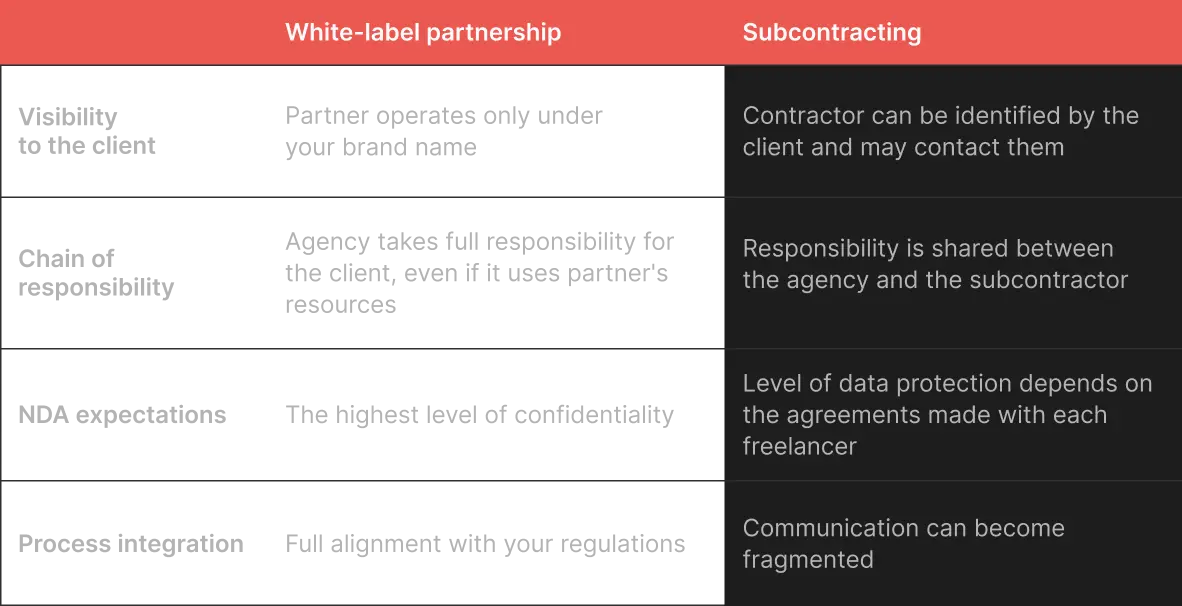
In a white label partnership, a chosen partner handles certain tasks, but the agency keeps control of agency brand ownership and manages client communication.
With subcontracting, clients know who the contractor is, but in the white-label agency model, the contractor stays confidential. Let's look at the white-label vs subcontracting comparison table below.
The Real Economics: In-House Hire vs White-Label Partner
Let’s look at the cost of hiring vs outsourcing. The total cost for an in-house employee covers salary, taxes, benefits, insurance, licensed software, equipment, office space, and management, no matter how many projects they complete.
With a white-label model, you only pay for project milestones or hours worked. There are no expenses for sick leave, vacations, or urgent replacement searches, so your agency margin grows. Onboarding a new specialist can sometimes take months, but a partner provides access to their expertise from the first day, and there are no variable delivery costs.
Where White-Label Delivery Works, and Where It Doesn't
Certain services should stay as the agency's core competency. Below, we’ll review some specific examples of white-label limitations.
.webp)
For example, a Swiss marketing agency needed to launch a platform with 36 animated pages. Instead of going through a long in-house hiring process, they chose to partner with us. This way, they quickly got a skilled team and kept the project profitable and high-quality.
7 Signs Your Agency Is Ready for a White-Label Partnership
Are you wondering if your agency should use white-label solutions? If you recognize any of these agency scaling signs, it might be time to rethink your usual approach to agency capacity planning.
- You often have to decline new contracts because your agency focuses on a narrow area.
- The quality of work from freelancers is inconsistent, and many tasks have to be redone.
- Clients ask for complex services that your team is not equipped to handle.
- Staff costs are higher than what you earn from projects.
- Project managers spend most of their time dealing with urgent problems.
- Your order volumes are seasonal or hard to predict.
- You want to expand your agency’s product line quickly, but your budget is limited.

Alex Lozitsky
Co-founder and CEO
How to Choose (and Vet) a White-Label Partner Without Getting Burned
White-label partner vetting should consider several key selection criteria:
- Reporting standards (using templates that match your agency's brand);
- NDA requirements, including confidentiality and non-compete clauses If the partner will handle customer data, they must also guarantee GDPR or CCPA compliance;
- White-label SLA and clear dispute resolution procedures.
For example, in web development, it’s a warning sign if the contractor does not have a dedicated project manager or if communication deadlines are unclear.
Without clear white-label contract terms, your agency could risk its reputation with the client.
What a Well-Structured White-Label Engagement Looks Like
If you don't have a clear white-label delivery process, even the best contractor can disrupt your smooth workflows. To avoid this, consider following this agency partnership structure:
- Define the project scope and standardize how tasks are handed off. Use a detailed project brief, a checklist to confirm readiness, and keep all documentation consistent.
- Set up internal communication channels that the client does not see. Make sure the end client communicates only with your agency, not directly with the contractor.
- Hold regular demos and provide real-time access to burndown charts. Present these updates to the client as your agency's own work.
- Use flexible engagement models. For some projects, evaluate contractor performance by hours worked, and for others, by completed milestones.
- Set up a QA process that includes both contractor testing and a final review by your own QA specialist. Besides, create an escalation workflow that explains who is responsible for resolving issues and how quickly they should respond.
Here’s an example of a white-label workflow:
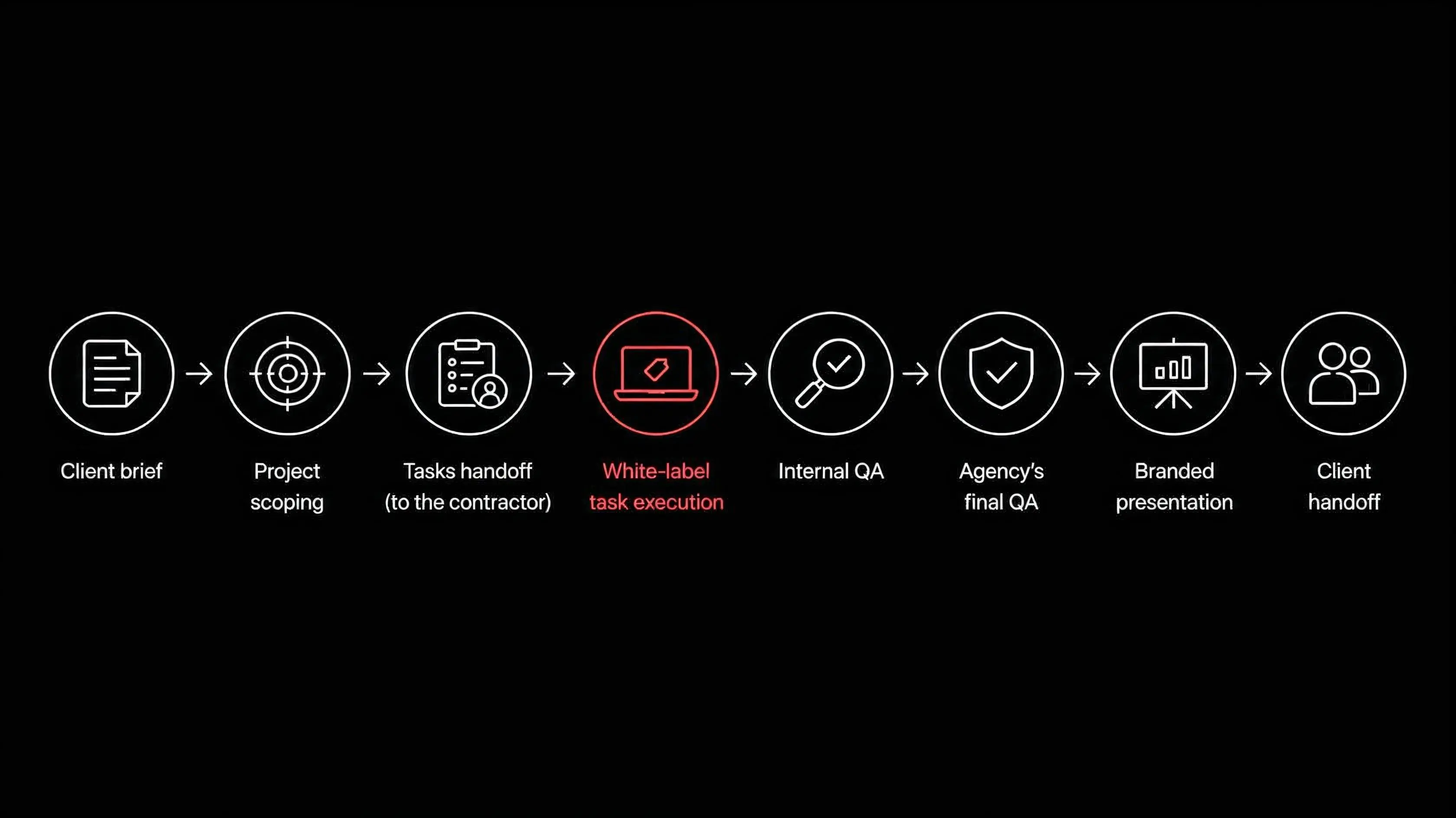
We selected this workflow for the Rocken platform as it evolved from a basic WordPress site to a Laravel and Vue.js ecosystem.
This shift helped the client’s business grow steadily without extra management challenges.
Rather than spending months retraining staff or updating the tech stack, the agency trusted us with the technical transformation. As a result, business metrics improved without the cost of a large IT department.
Build In-House vs Go White-Label: A Decision Framework
Which is the better choice: build vs outsource agency?
.webp)
A reliable agency staffing strategy is to use a hybrid delivery model. Keep your core experts in-house, and let a trusted white-label partner handle operational tasks and specialized projects.
Our eight-year partnership with Nettavisen, a leading Norwegian media company, shows why many large businesses use both long-term white-label outsourcing and in-house teams. To build high-load platforms that support more than 100,000 users and handle busy times like Black Friday, companies need quick access to dependable engineers.
By working with us, Nettavisen avoided problems with staff turnover and infrastructure downtime, so their systems stayed stable even during heavy use and met Norwegian rules.
Final Thoughts
Growing your project delivery and expanding your in-house team are two separate challenges. If your daily operations are slowing down your sales, we are ready to talk about white-label development partnerships that can help your business grow faster.
Alex Lozitsky
Co-founder and CEO