.png)


The rush to get a product to market ASAP forces developers to make compromises. Because speed is more important than perfect code, these compromises turn into technology debt in the long run.
Have you seen your support and implementation costs for new features rise quickly? This means that the costs of the outdated architecture may already be affecting your profits. To fix this, try to find the right balance between how fast you release updates and how you design your system.
Why Companies Underestimate Portal Architecture at the Beginning
When a team works on a digital product, stakeholders often want quick results (i.e., implemented user functionality), ignoring the requirements for a digital platform's scalability. This focus on commercial goals (such as showing the interface and buttons) can leave off the development agenda important needs like fault tolerance, data domain isolation, and, naturally, horizontal scaling.
When a portal infrastructure is built to handle, for example, 100 users at once, that setup often becomes permanent. If user numbers suddenly grow, teams may not know how to respond. Here are some examples of architectural burnout:
B2B SaaS platforms, which often begin with a monolithic architecture with a shared database. This setup makes it nearly impossible to keep data fully separate or meet strict regulatory requirements.
Internal enterprise web portals, which are typically built as interface add-ons for legacy systems, eventually accumulate hundreds of uncontrolled internal links. If a single SQL query is not optimized and crashes, it can paralyze the work of several departments at once.
Customer-facing portals built without dynamic caching or CDNs can slow down even during minor traffic changes. This drop in performance often leads to fewer conversions.
What Happens When a Portal Is Built Without Long-Term Scalability Planning?
When teams do not fully understand how portal scalability works, the platform ends up with fragmented integrations. Each new API connector lacks a clear orchestration pattern. This often leads to performance problems, when latency in a single third-party service blocks the entire UI flow. Onboarding becomes too complex and requires an engineer’s intervention to configure each new account. Analytics modules face limitations when data aggregation for large reports puts too much strain on transactional databases. This causes cloud costs to skyrocket.
For ecommerce businesses, disconnected systems can create problems with product data, pricing, inventory, and order processing. A well-planned portal architecture connects these systems and keeps information in sync.
To make the distinction clearer, let's compare the outcomes of two different architectural approaches: a short-term MVP architecture (without enterprise software scalability) and a long-term, scalable portal platform architecture.
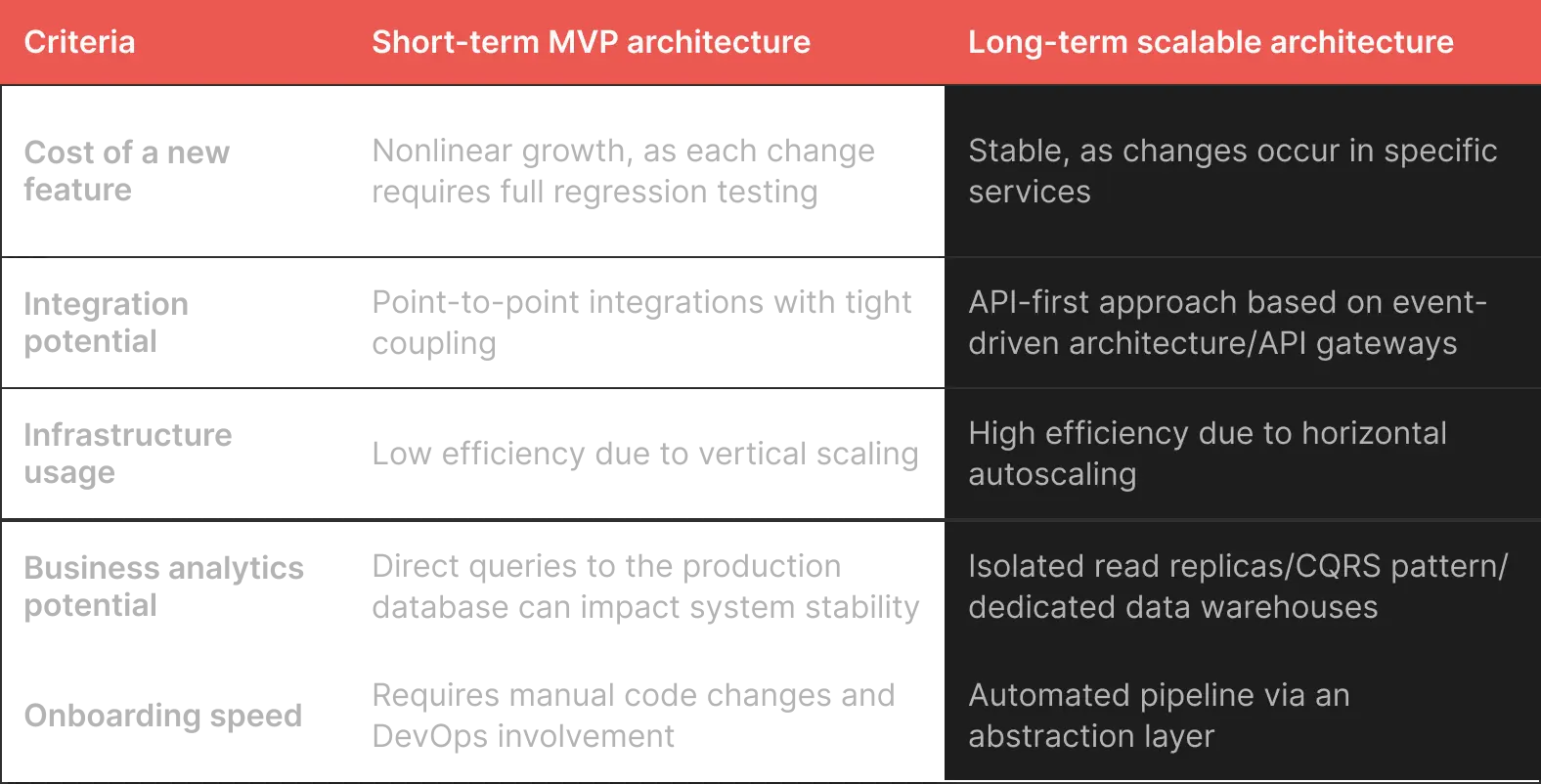
The Real Cost of Software Technical Debt in Portal Development
Accumulated software technical debt results in significant financial losses. This can be explained by duplication of business logic, unstable synchronous integrations (instead of asynchronous queues), and the lack of automated test coverage.
As a result, engineering costs increase with each month, while the speed of new feature releases steadily declines. The team itself faces developer dependency risks when only a couple of specialists thoroughly understand this poor software architecture, and their leaving means the entire development team becomes helpless.
Let's analyze the consequences of technical debt in more detail:
- Operations teams struggle when there is no automation and data is out of sync, so back-office staff have to enter data by hand;
- Slow onboarding, when new clients wait several days for tech support to check their data;
- Customer retention drops due to crashes and lags in the interface;
- Security vulnerabilities, when a quick update of dependencies and libraries is not possible.
If you are unsure about the amount of software technical debt or whether you need long-term software maintenance, take a look at this checklist:
- Regression chaos happens when even a small patch breaks the system’s logic;
- Time-to-market gets worse, so developing a new feature now takes several weeks;
- Linear database growth as traffic increases;
- Your tech team avoids frequent releases, and the deployment process is still controlled manually;
- Lack of observability means you only hear about critical errors from upset customers;
- Custom code, when each new client needs a separate branch in the repository;
- Too high infrastructure costs, and your cloud bills grow faster than your revenue.

Alex Lozitsky
Co-founder and CEO
Why Customer Portals Fail to Scale Operationally
When the user base begins to grow, poor customer portal scalability instantly transforms into customer support overload. Instead of timely automation, the company is ultimately forced to hire new staff to manually handle tasks the customer self service portal can't handle on its own.
If there is no end-to-end integration, the system just sits on top of a mix of disconnected SaaS tools. Data has to be moved between internal systems either manually or with unreliable scripts. This leads to a lack of operational visibility, where management cannot monitor the customer journey. Customers then end up with poor self-service options and often need support for even simple tasks.
Here are a few examples of industries that face typical customer portal scalability issues:
B2B SaaS
Due to the lack of role-based access, clients cannot manage their employees' permissions. This leads to onboarding bottlenecks, when connecting a new enterprise department requires interaction with the vendor's technical support.
Healthcare
When a patient portal is designed without standardized data orchestration, manual workflows paralyze the system. At some point, patients can no longer receive test results on time due to delays in synchronous APIs between labs and the customer operations platform itself.
Fintech
Due to the platform's inability to process transactions in real time, KYC/AML becomes a challenge. Clients face delays during onboarding because the different document verification modules are unable to share their verification status.
Logistics
The lack of a real-time architecture leads to desynchronization of cargo status data. Clients see outdated information, which leads to endless calls to call center operators.
Hidden Infrastructure Costs Businesses Discover Too Late
When an enterprise portal architecture has compromises, it often leads to hidden infrastructure costs. These systems usually lack features like dynamic caching, message queues, and read/write database partitioning, which means the monolith does not use computing resources efficiently. Another expense associated with rebuilding legacy systems is security redesigns and emergency compliance retrofitting. Custom APIs may face their own limitations as well.
So, the overall migration complexity makes portal modernization comparable in cost to building a new system. If you still doubt which approach is better for you, check the table below.
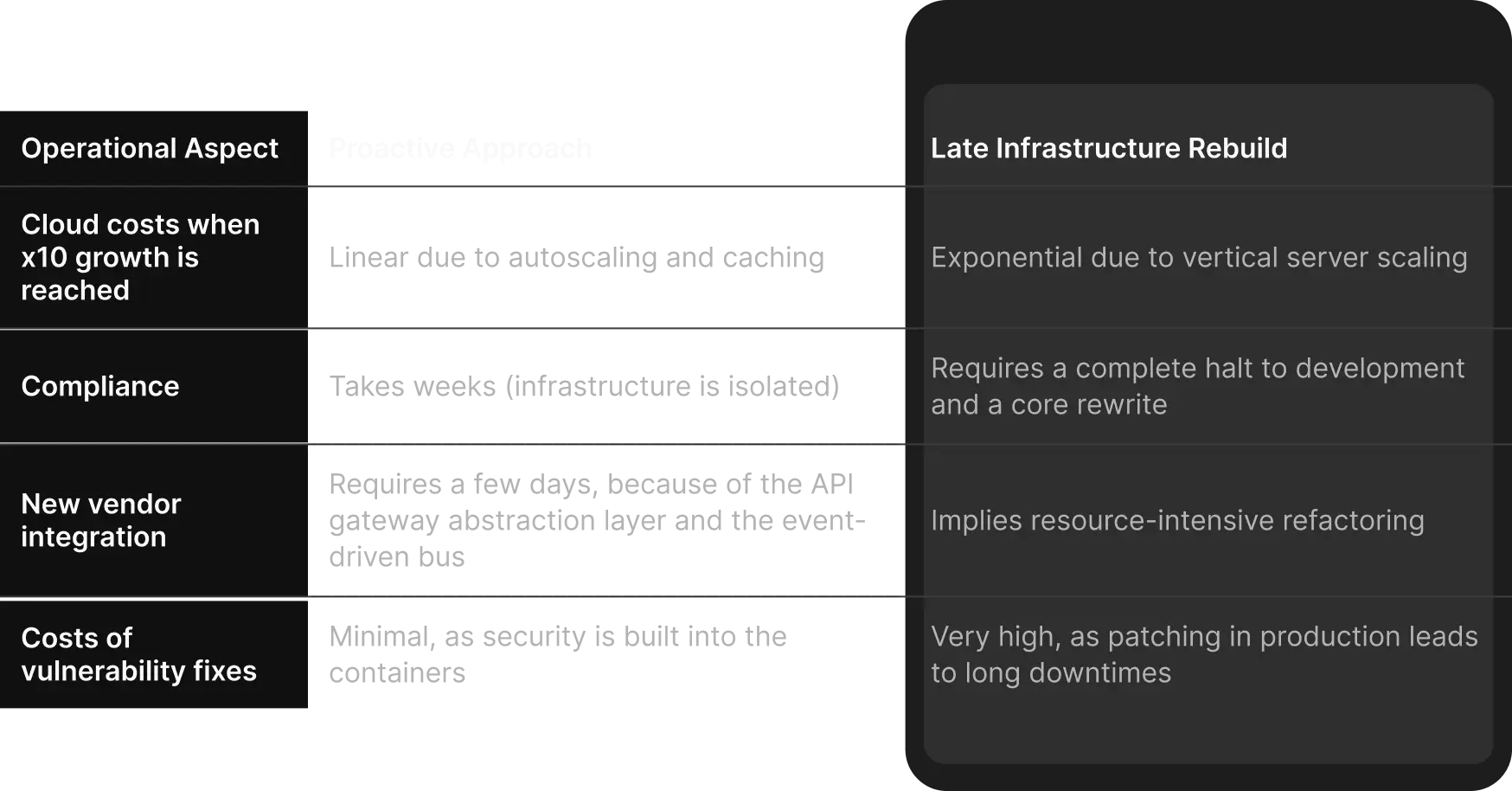
Customer Experience Suffers Faster Than Most Teams Expect
Poor digital customer experience implies slow interface response times, session drops during authorization, complex navigation, and other issues. All this leads to low adoption rates. On the other hand, a well-designed backend architecture can improve the following business metrics:
Customer retention. Too slow customer onboarding causes users to leave for competitors before the trial period is over;
Onboarding success. If users face inconsistent workflows within a customer onboarding platform, they may not be able to set up their profiles on their own. This makes it much harder for them to see value quickly.
Operational trust. In fintech and logistics, any delay in showing balances or cargo status can create financial risks and damage the brand’s reputation;
Customer success. Instead of working with new accounts, the customer success team becomes a technical support service and is forced to manually fix bugs in the portal user experience.
Build for Scale Early: What Modern Portal Architecture Looks Like
To make sure your platform is viable, start by building an API-first architecture from the outset, where the frontend is completely separated from the backend and communicates with it through an API gateway. Choosing a cloud-native portal architecture also lets your team update internal business logic and scale up without disrupting current processes.
Here are the main features of this type of enterprise integration architecture:
- Modularity, with the core divided into isolated services with their own databases;
- Authentication systems and role-based access, with the implementation of external identity providers via OAuth2/OIDC;
- Workflow automation based on event-driven engines and message queues (for asynchronous processing of heavy requests);
- Analytics infrastructure, where the transactional workload is separated from reporting through data replication in data warehouses;
- AI-enhanced operations at the API orchestration level for auto-scoring and ticket categorization;
- Scalable integrations in the API abstraction layer, needed for instant connection of third-party SaaS services.
To better understand these features, let's look at a specific example of a scalable SaaS architecture used in an enterprise setting:
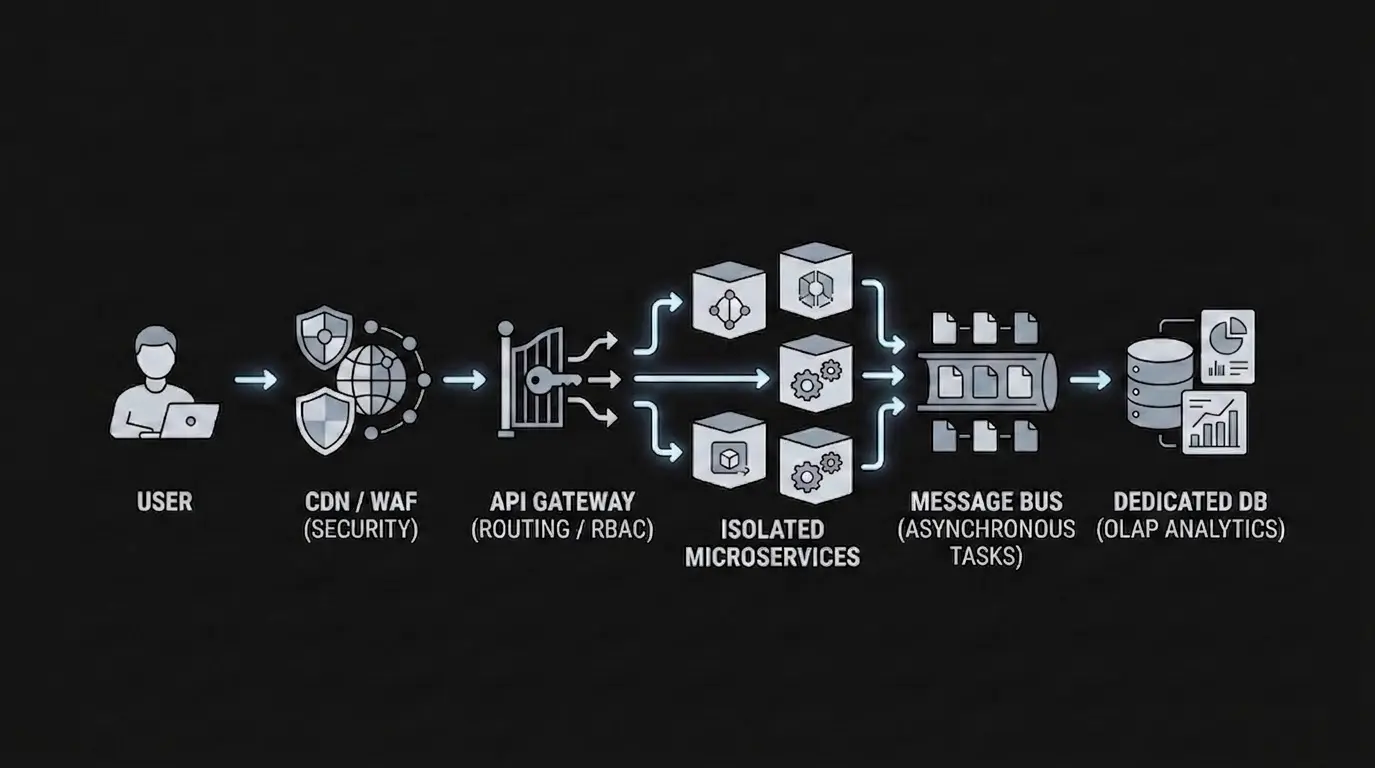
In this setup, the frontend and backend are kept separate. If there is a bug in one part, it will not cause the whole platform to fail.
We also have a few real-world examples of this architecture, including:
- Roсken, a hiring platform, designed to make communication easier between candidates, clients, and career consultants (this approach has led to a 182% increase in clients for its owners).
- A digital competitions platform that supports four custom games and has maintained 100% uptime (the system can handle millions of requests at once without affecting the user experience).
- HR digital platform offers end-to-end workflow automation, includes six helpful calculators, and makes it easy to manage content in multiple languages.
Build vs Rebuild: Why Delayed Architecture Decisions Become Expensive
Refactoring works well if the main issues are unoptimized queries and/or outdated libraries. However, if your business has platform scalability challenges, you will likely need to rebuild the portal. In these cases, the biggest challenges are moving data and avoiding downtime. With the right portal transformation strategy you can keep these risks to a minimum.
To help determine the right path forward, let's compare the key differences between refactoring an existing solution and legacy portal modernization from scratch.
.webp)
Final Thoughts
Technical debt creates operational complexity. As customer expectations continue to rise, a scalable enterprise portal architecture becomes a real market advantage. The CheIT team has hands-on experience in designing and maintaining scalable systems. If you want to learn more, please get in touch.
Alex Lozitsky
Co-founder and CEO