.png)


Imagine your top management asks for artificial intelligence to increase the company’s value by 30%. You spend six months and over $150,000 building a RAG pipeline, but you could have reached the same goal with a simple feature, saving time and money.
How do you know which AI product vs AI feature decision is right for you?
Why "We Need Artificial Intelligence" Isn't a Scope Decision
Pressure from senior management or investors often leads to fast implementation of artificial intelligence, without first understanding its real value. The term "artificial intelligence" can mean anything from a simple automation script to a complex app, but these options have very different costs and timelines.
Because of this confusion, teams often fall into one of two AI strategy confusions. The first one is turning a simple support task into a big project, which wastes resources. Other times, teams try to fix a complex problem with a simple tool, which usually does not work well.
Before adding AI into your business, it's important to correctly define the business problem you want to solve. Instead of asking, "How do we integrate a model?" start by identifying the specific issue and AI scope planning.
What Actually Defines an "AI Feature"
Let’s start with an AI feature definition. It’s something that improves an existing product or workflow. You don't have to prove its value on its own or prove it can succeed in the market. An AI feature usually has these qualities:
- Narrow-scope AI use, meaning either one task, one user scenario, or making one clear improvement. For example, this could be autocomplete in a search bar or prioritizing support tickets;
- It needs only a small amount of data and infrastructure, since it works with data the main product already collects;
- Success metrics, based on the main product's metrics (usually faster task completion, reduced support load, etc.).
An example of an AI-enhanced product is adding call summarization to a CRM, which can save a business about 10 minutes per transaction. You might wonder if this puts you behind your competitors, but many companies are still experimenting with AI. In fact, almost two-thirds say they haven’t started using AI widely across their workflows.
What Actually Defines an "AI Product"
Let’s talk about AI product definition. It should prove its value both in the market and for your business, considering both its cost and how it will be used.
Here are the main features:
- Autonomy, which means you need to create a custom data strategy, set up separate infrastructure like vector databases and pipelines, and plan your go-to-market approach;
- There are higher upfront costs, and it takes longer to see results, but your company gains a new competitive advantage;
- The need for a dedicated team, since AI product requirements for development and support go beyond a side project for your current team.
To see when to build an AI product makes sense, here’s an example from our experience.
We built an AI-powered platform for American commercial furniture designers. It included smart floor plan analysis, a tool for creating 3D visualizations, and automated documentation. This helped our client cut plan generation time by three times and reduce documentation costs by 80%. So, a well-designed product with real market value can quickly make workflows much more efficient.
Below is a table comparing the criteria for an AI feature vs an AI product:
.webp)
The Cost and Risk Difference Businesses Underestimate
When companies start planning their AI development costs, they sometimes treat a single improvement as if it were a full autonomous system. In reality, the costs can be very different depending on the size of the project. Here’s why:
Data needs are different
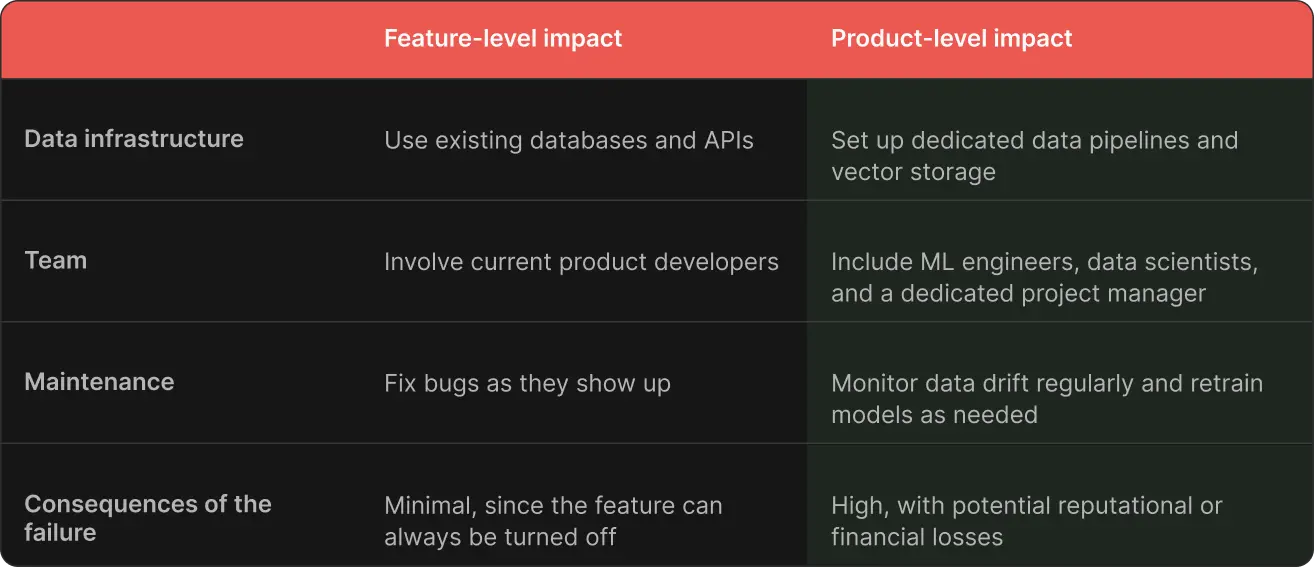
For a basic feature, existing company databases usually work, but a full solution often needs a new data pipeline and higher data quality standards to avoid common mistakes.
Team requirements also differ
Developers working on an existing product can add a feature during regular sprints. Building a full product, though, needs a dedicated team with specialized skills.

Alex Lozitsky
Co-founder and CEO
Support costs are not the same
The scope of work for AI feature maintenance is minimal. In contrast, a full product needs ongoing spending for things like model monitoring, data drift control, and retraining.
Different scale of risks
If a feature does not work well or is not useful, it can be removed from the interface. But if a big project fails, it can use up the budget and hurt the company’s reputation.
Now, let’s look at the AI feature and AI product risks and costs in the table below:
How to Decide What You Actually Need
Set up an AI decision framework to keep your roadmap clear. This approach helps you see your current position and choose your next steps.
- Start by focusing on the business problem instead of getting caught up in the excitement of new technology. You need to determine which performance metrics should improve after implementing AI.
- Evaluate the integration potential. Decide whether the feature will be an add-on for an existing product or launch it as a separate offering in the market.
- Perform an AI readiness assessment at the company level. This requires an audit of current data readiness, the workload of your existing product team, and management's willingness to invest in new infrastructure.
- Test demand with a minimal scope. Starting with feature-level integration is usually more affordable and lets you test your idea before committing to full development.
Here's a quick checklist to help you compare feature and product scoping.
- Does this feature address a user's pain point in the current workflow, or does it need a new use case?
- Is the existing data sufficient to implement the feature, or does a separate data pipeline need to be built?
- Will we measure success by current product conversion or retention, or do we need to set up new financial metrics?
- Do we have a monthly budget set aside for model support and quality monitoring?
- Can our current product team handle this, or will we need AI or ML specialists?

This is an example of how targeted automation can grow into a complete system. Our team was asked to move over 300 separate Zapier scripts into one unified setup using n8n, PostgreSQL, and OpenAI.
At first, the client created new processes for each customer, which caused repeated logic and frequent failures because there was no central monitoring. To solve this, we used AI to organize and classify incoming responses.
As a result, onboarding new customers dropped from 1.5 hours to just 7 minutes. Switching to a product-based approach also lowered operating costs and gave the company a solid base for growth.
Mistakes Businesses Make With AI Scope
Are there any common AI implementation pitfalls? Absolutely. Here are five of the most frequent AI scope mistakes companies make when trying to integrate artificial intelligence:
- Adding technology just to impress investors, without understanding how it actually benefits the company;
- Choosing an overly complex infrastructure for a problem that could be solved with a simple add-on;
- Not setting clear success metrics, such as launching a feature without connecting it to the main product’s goals;
- Overlooking support costs: this AI project mistake appears when companies evaluate only coding, forgetting about expenses for tokens, retraining, and other ongoing needs;
- Skipping rapid validation can be a problem. This happens when you launch a large project without first testing individual functions.
Before you decide how to introduce artificial intelligence, make sure you avoid these common mistakes.
Final Thoughts
Many companies just need to improve their current products rather than build something entirely new. It's smart to start small when planning AI product development, testing your ideas with minimal effort. If the results are promising, you can scale up later.
At Che IT, we develop practical AI solutions and always choose the approach that will bring you the most value.
Alex Lozitsky
Co-founder and CEO