.png)

You’ve launched your MVP, users are signing up, and now your team has real product data to work with. Soon, new questions come up: Which problems should you tackle first? Which feature requests are truly important? How do you know when your product is ready to move past its MVP stage?
Many teams try to answer these questions by adding whatever seems most urgent each week, but this often leads to a bigger backlog and no clear plan for reaching version 1.0.
If your product is at this stage, it’s time to update your roadmap.
Why the MVP-to-v1.0 Transition Is a Different Problem Than the MVP Itself
An MVP answers a narrow question: does the product solve a real problem well enough for someone to use or pay for it? Version 1.0 answers if people can keep using the product without the team constantly rescuing it. This shift affects your planning approach.
When building an MVP, uncertainty is your biggest challenge but after launch, you will have evidence you did not have before. Some users drop out at certain steps, some features get used often, and requests to your support team will uncover recurring issues.
This is where many teams get stuck in MVP mode. They continue shipping fast, adding requests, and taking shortcuts because that approach worked to reach launch.
If you are still shaping your first product, our step-by-step MVP guide covers the decisions that come before launch. For teams trying to protect scope during that stage, see how to avoid MVP scope creep.
But this approach stops working once your product becomes part of someone’s daily routine.
Consider these three examples:
SaaS MVP
The next challenge is making reports reliable, setup easier, and getting customers to return every week.
Marketplace MVP
Version 1.0 may depend on better matching, decreasing failed transactions, clearer trust signals, and better working marketplace economics.
Internal B2B tool
Once several teams depend on it, permissions, auditability, error handling, and ownership become product requirements.
The post-launch product mindset here means moving from proving demand to building something people can count on every time.
SVPG makes a similar distinction between building to learn and building to earn. Once the product has evidence behind it, the team needs to focus increasingly on outcomes rather than simply producing features.
Here’s a simple test you can use:
If you removed half the features from your roadmap, would you know which ones protect retention, revenue, or the core user workflow? If the answer is no, your product probably hasn’t reached the next stage of maturity yet.
Collecting and Filtering Post-Launch Signals
The first step after MVP is to build a clear picture of what’s really happening.
You usually have four major signal sources: product analytics, customer support tickets, user interviews, and churn, cancellation, and exit feedback. Each source gives you a different perspective.
The table below breaks down the strengths and limitations of each signal source.
.webp)
A practical system for product analytics for prioritization can use three levels:
- Observation: one user reports a problem.
- Pattern: the same issue appears across several users or sessions.
- Product problem: behavior, feedback, and business impact point in the same direction.
Factor in that your threshold depends on traffic, customer concentration, and the cost of acting.
A B2B product with 30 customers may have enough evidence from five customers representing a large share of revenue, but a consumer product with 100,000 users needs a different threshold.
Choosing a Prioritization Framework for This Stage
Once you have filtered the signals, you still need to decide what gets built. A product roadmap framework can help here as it should make decisions easier.
Three common options work well for different situations. The table below shows how RICE, Now-Next-Later, and Kano can be used at the post-launch stage, along with where each framework has limits.
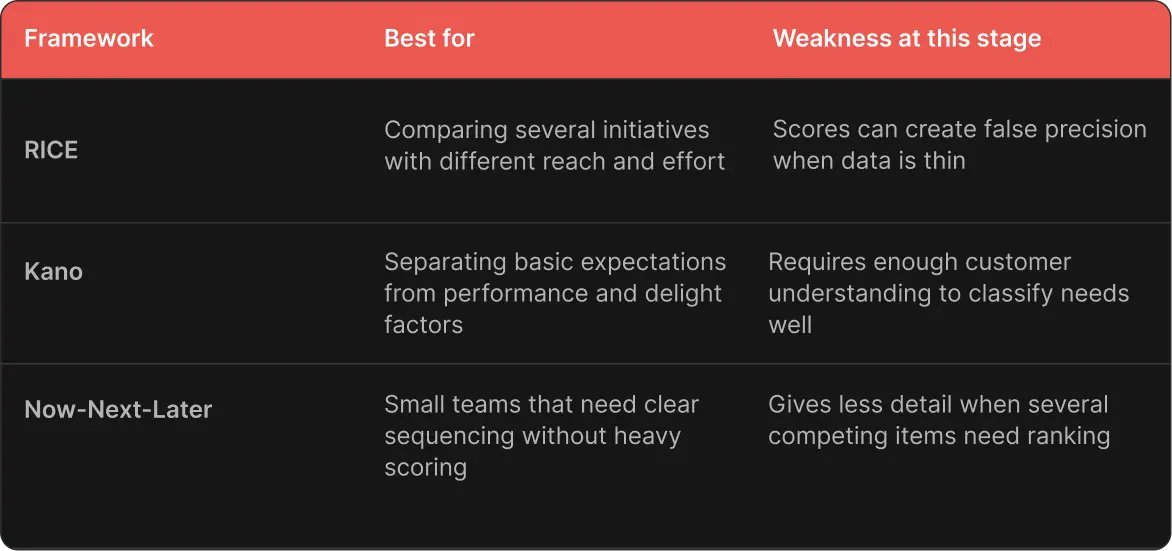
For startups, the best prioritization framework is usually the one your team can use every week without arguing over the scoring system.
Here’s a helpful tip: if your team has 80 items in the backlog, scoring all of them won’t help. Start by grouping them into a few main product problems.

Alex Lozitsky
Co-founder and CEO
Structuring the Roadmap to Version 1.0
It’s easier to manage your roadmap to v1.0 if you break the work into three stages.
1. Stabilize
Fix the problems that prevent reliable use, typically including critical bugs, failed core workflows, slow or confusing onboarding, payment and account problems, and basic monitoring and recovery.
2. Differentiate
Once the core product works well, focus on the features that make customers choose it and keep using it.
3. Scale
Invest in a broader scale only after the first two stages show you evidence, because this structure keeps you from making everything a top priority.
The table below shows the main question to answer at each stage and the typical output for each one.
.webp)
Your roadmap is more believable when your team can explain what you’re not building yet and why.
Communicating the Roadmap: Team, Investors, Users
An internal roadmap and a public roadmap serve different purposes.
Your team needs enough detail to make decisions and coordinate work. Investors usually need to understand the product direction, major risks, and expected business outcomes. Users want to know where things are headed, but you shouldn’t make promises your team can’t keep.
.webp)
Be clear about your direction and only share dates when you’re confident you can stand by them.
6 Signs Your Product Isn't Ready for Version 1.0 Yet
Use this v1.0 readiness checklist before committing to a major release.
- Most users stop using the product after the first week
- Most support requests are about bugs, not new features
- You don’t have a clear way to measure activation
- New users still need a lot of help to get started
- The main user flow keeps changing every sprint
- You haven’t defined what “ready for launch” means
These are signs to check if you’re ready to launch, but they aren’t always reasons to delay.
For example, a B2B product may need some manual onboarding for high-value customers. That alone does not block v1.0. The problem appears when the team cannot tell which manual work represents a temporary sales process and which work exposes a product weakness.
Likewise, some technical debt after MVP is normal. The question is whether that debt now creates recurring product risk.
To see how a real product changed and what decisions made it possible, take a look at the Rocken case study.
%20(1).webp)
Common Mistakes When Moving from MVP to v1.0
1. Chasing new features instead of fixing retention
Adding a new feature can feel like progress because it’s something you can see.
If users abandon the core workflow, adding another capability may simply create more surface area around the same problem.
2. Ignoring technical debt accumulated during the MVP sprint
Find the technical debt that affects reliability, speed, security, or the core user experience. Fix the issues that could hold back the next stage.
3. You don’t set clear v1.0 goals
Decide what “ready” means before you start building. Make sure you set clear targets for activation, core workflows, bugs, onboarding, and monitoring.
4. Taking every user request as a priority
Five customers asking for the same capability may matter, and one large customer asking for something highly specific may also matter. Neither request should skip your team’s product judgment.
5. Preparing for scale before you need it
Teams sometimes prepare their product for millions of users, but often struggle to keep their first thousand users. Keep in mind that your infrastructure should match your current demand and your product’s next stage.
Final Thoughts
Che IT Group works with early-stage companies beyond the initial MVP, helping teams assess what they have learned, define the next product priorities, and build the technical foundation for the next stage.
Alex Lozitsky
Co-founder and CEO