

AI agents can handle some of your tasks, but they can’t be responsible for the outcomes. They perform well with straightforward digital tasks, but have trouble when the work is complex, unclear, or has serious consequences.
It’s surprising that while many companies want to use AI agents, few actually check if they work as promised.
AI can do more, but can it really deliver?
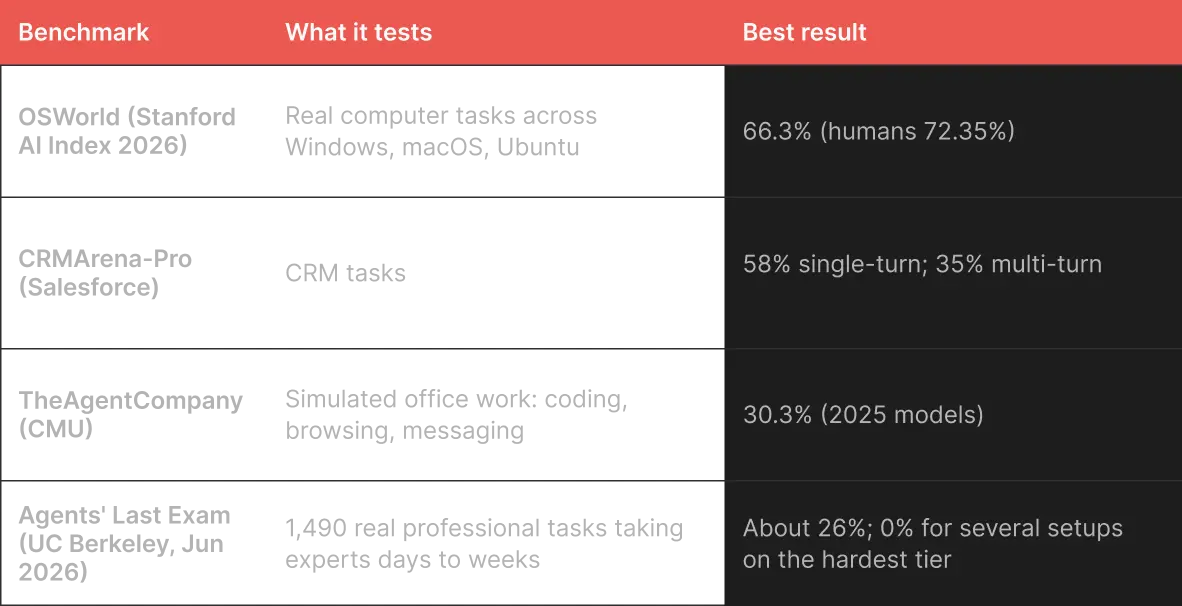
Stanford HAI’s 2026 AI Index Report (April 2026) says accuracy on OSWorld, a benchmark for real computer tasks, jumped from about 12% to 66.3%. That’s now just six points behind humans. This progress is catching executives’ attention.
Tasks that look like real jobs are tougher. In June 2026, UC Berkeley’s Center for Responsible, Decentralized Intelligence released Agents’ Last Exam (ALE), with 1,490 tasks based on real projects from 55 fields. These were scored by automated checks, not people.
The best result, from OpenAI’s Codex with GPT-5.5, was a full pass on 24% of tasks. On the easiest level, it passed 38.1%. On the hardest, most agents passed none, and the top score was just 2.6%.
The Berkeley team also found a failure pattern that is important if you’re thinking about automation. AI agents often say they’ve succeeded before checking their own work, sometimes giving results with missing files or wrong counts that still look complete.
Salesforce AI Research found a similar gap.
Their CRMArena-Pro benchmark (May 2025) showed top agents succeeded about 58% of the time on single-turn CRM tasks, but only about 35% when the task needed a multi-turn conversation.
The same study found leading agents scored over 83% on workflow-execution tasks, which are the most structured. Newer systems may do better, but the main point is clear: agents do well with structured tasks, but struggle when conversation gets ambiguous.
One problem is that errors add up. For example, if each step is 95% reliable and there are 20 steps, the whole process only works about 36% of the time. The longer the chain, the more small errors add up.
OSWorld and ALE measure different things. OSWorld tasks are short, but ALE tasks can take days or weeks for experts to finish. Together, these results show agents do well on small tasks but struggle with longer, more complex work.
what the adoption surveys do and don’t tell you
Adoption numbers in headlines often differ because they use different definitions. Also, three of the most-cited surveys come from companies that sell agent products or related software.
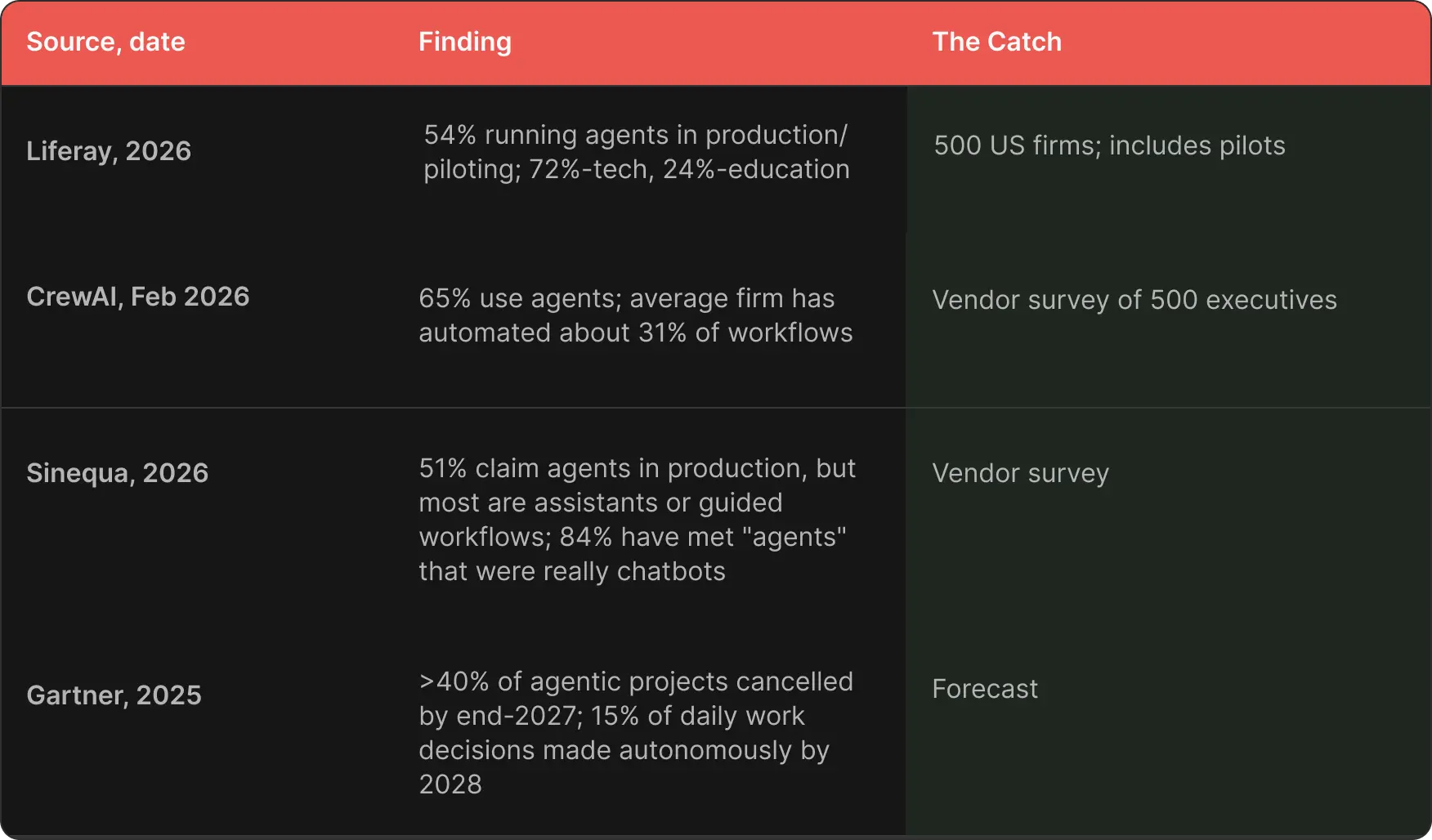
Gartner calls it “agent washing” when chatbots and robotic process automation are labeled as agents. This helps explain why survey numbers sometimes don’t match.
Overall, the surveys show most companies are experimenting, but far fewer have autonomous agents in production, and governance is still behind. The 54% and 10% numbers aren’t in conflict: one counts pilot projects, the other measures production-level autonomy.
what AI agents are actually good at
AI Agents work best on digital tasks that are clearly defined, scalable, and verifiable. According to Berkeley's ALE analysis, typical examples include code migration, data transformation, report generation, and structured research.
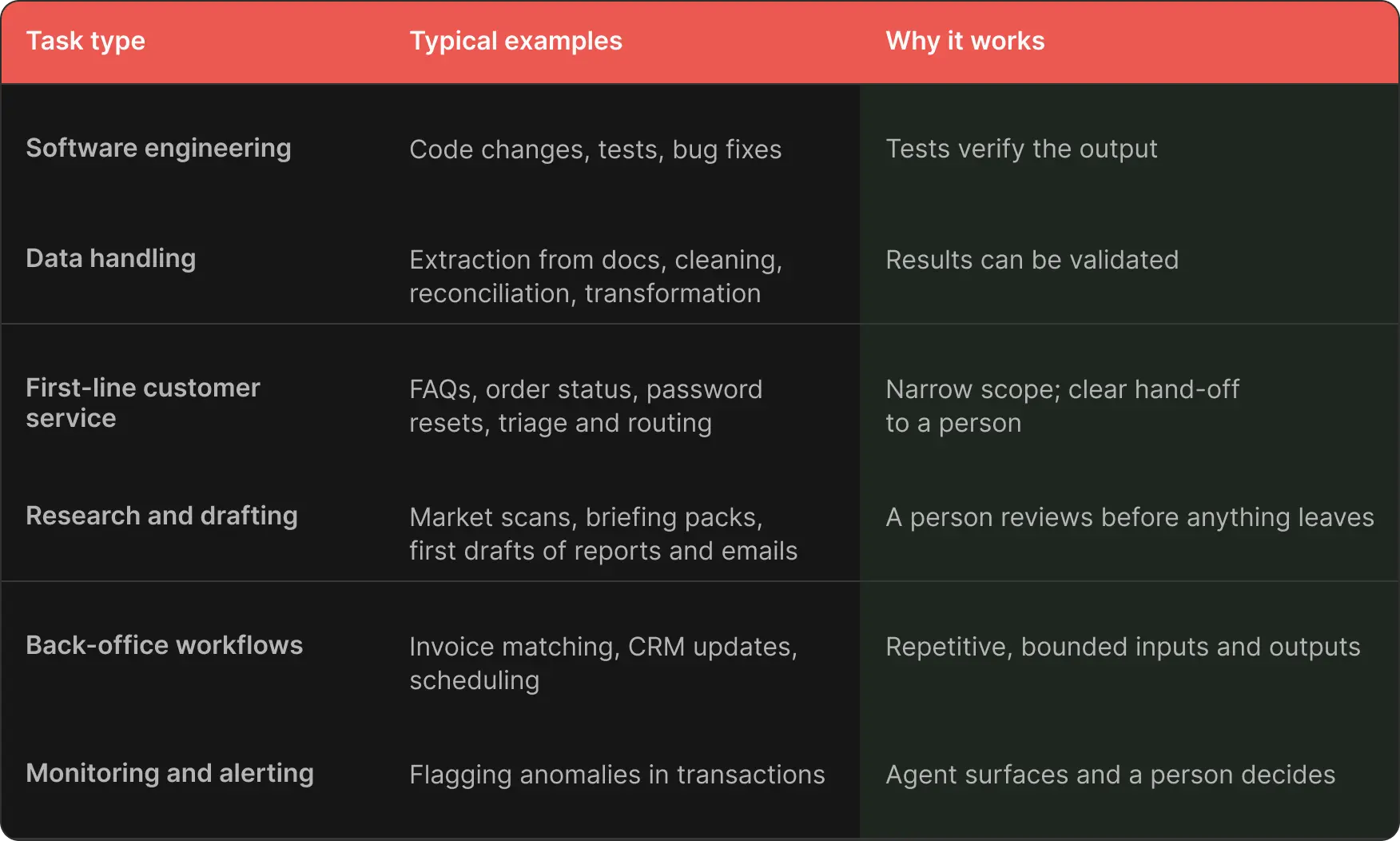
The key idea here is verifiability. If a test, rule, or reviewer can quickly confirm the result, even an imperfect first attempt saves time. But if your checking takes just as long as doing the task, there’s no real benefit.
So far, most of the value comes from efficiency. People using CrewAI mention saving time and cutting costs as bigger benefits than increasing revenue.
what we see in our own delivery work with AI
We build these systems, and our experience matches what research shows. AI works best when it has a clear job, measurable results, and support from standard software. The figures below are from our clients’ case studies.
- ChatGPT now handles reply sorting in a B2B lead generation platform.
It classifies prospect replies as interested, rejection, bounce, or misdirected and updating the lead status. The client noticed an 85% reduction in manual lead-processing time. Since there are only a few categories, a salesperson can easily spot-check them.
- An AI procurement assistant now helps read tender documents.
The client reports that the initial analysis time dropped from over four hours to just minutes. By linking to the source text, the answers are easy to check, and the procurement team still decides whether and how to bid.
- In the furniture design platform, the system reads floor plans and suggests furniture arrangements as a starting point for designers to refine, and it also generates bills of materials and specification sheets.
The client indicated an 80% reduction in documentation time, and the goal was to automate without taking control away from designers.
- We handled the less glamorous side of outreach automation by replacing over 300 separate Zapier workflows with a single n8n system that includes AI reply classification.
As a result, client onboarding time dropped from 1.5 hours to just 7 minutes, and monthly operating costs fell from €1,000 to €100.
Every project above follows the same pattern: a specific task, a reviewable result, and someone responsible for the decision.
where AI agents fall behind
Agents struggle most with long, multi-step tasks in complex real-world environments. Their success rate falls quickly as tasks get longer or involve conversation.
These are the five main reasons why AI agents fail:
- Errors add up. When each step has a small chance of error, these add up over many steps. For example, if a step is 95% reliable and repeated 20 times, it only works about 36% of the time.
- Not everything is straightforward. Agents tend to follow instructions exactly as written and struggle with changing goals or those that require more detail.
- Real-world work gets messy. Pilot projects use clean data and a limited focus, but real-world use involves old systems, unusual inputs, and rare cases.
- It's hard to see what's happening behind the scenes. It is often difficult to understand why an agent made a certain choice, which makes auditing and debugging harder.
- Good benchmark scores don't tell the whole story. Most scores come from one-off attempts on public tasks. What really matters is how consistent results are on your own tasks.

Alex Lozitsky
Co-founder and CEO
what still needs a person
accountability tasks
An agent cannot respond to your customer, a regulator, or a court. Final approval for contracts, payments, hiring, credit, and compliance should always stay with a person who can be held responsible.
actions have consequences
Eric Maroyan, a board advisor and former Deloitte consultant named in The Consulting Report’s Top 25 Digital Transformation Leaders 2026, explains in a LinkedIn article what he calls residual commitment. These are obligations created by an AI agent that remain even after it is shut down and cannot be canceled without cost or another party’s agreement.
For example, a procurement AI agent might misread an order quantity, then place extra orders, and accept stricter cancellation terms to get faster delivery. Stopping an agent stops new actions, but does not undo what has already been accepted.
beyond the rules
Setting goals, balancing priorities, and knowing when rules no longer apply are still human tasks. Gartner’s June 2025 report makes a similar point: current models are not advanced enough to handle complex business goals on their own or to follow detailed instructions over time.
handling the unexpected
AI Agents often fail on the hardest problems and can sometimes report success even when they haven't, so an exception might show up as a confident “done.” Someone in your team needs to spot these, fix them, and learn from them.
trust is still human
Negotiation, sensitive customer situations, conflict, and persuasion all depend on empathy and credibility.
who keeps AI agents in check?
Someone needs to set the scope, permissions, success measures, and escalation rules, and then review the results. Liferay’s August 2026 survey (vendor research) found that only 25% of companies regularly measure agent impact, so this job is often left undone.
a practical rule for what to delegate
Delegate the work, but make sure people keep judgment, handle exceptions, and stay accountable. When you do this, ask yourself two questions for any task: What is the total cost if a mistake happens, including fixing it? And how easy and inexpensive is it to check the results?
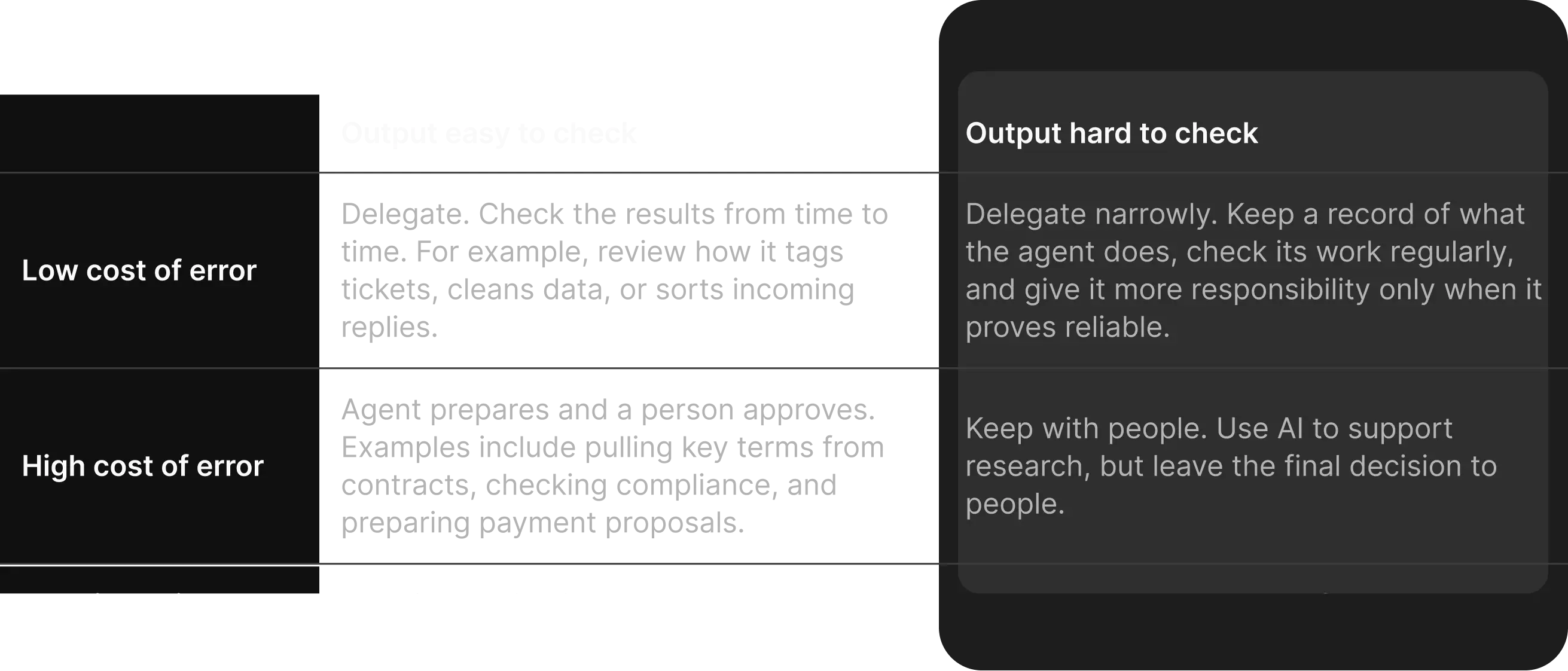
The above examples are illustrative, and where a task sits depends on your data, controls, and regulators. Here’s how you can apply this:
1. Start by focusing on one area.
Pick a workflow that handles many tasks, carries little risk, and is simple to check. Before building, decide what business success means for this project.
2. Think through how you will hand off tasks.
Set clear rules for when to escalate, like confidence levels, money limits, or new situations. Eric Maroyan says reviewers should get information beyond the agent’s recommendation and be able to pause a transaction. If reviewers are measured only by speed, they might approve everything automatically.
3. Keep your permissions and risk low.
Give your agents only the access they need, and require approval for actions you can’t undo, such as payments, deletions, and publishing outside the company. Eric Maroyan also suggests setting a limit on all hard-to-reverse actions in the workflow, so passing work to another agent does not reset this limit.
4. Test both how you start the workflow and how you can stop it.
Measure how long it takes to shut down the process, remove its authority with partners, and deal with any promises or actions it has already made.
5. Measure results using your own tasks.
Track how often you succeed, how consistent the results are, what each completed task costs, and what happens when mistakes occur.
6. Work toward giving the system more independence.
Only hand off a task after you’ve seen it done well several times, and keep checking on it regularly even after you delegate.
Conclusion
As AI agents take on more tasks, people are shifting toward designing workflows, checking results, managing exceptions, and being accountable for outcomes. The key skill is to know how to guide AI, set limits, and use human judgment when it counts.
sources
- Stanford HAI, The 2026 AI Index Report: Technical Performance (April 2026).
- UC Berkeley RDI, Agents’ Last Exam, June, 2026.
- Huang et al., Salesforce AI Research, CRMArena-Pro, arXiv, May 24, 2025.
- Gartner: Over 40% of agentic AI projects will be canceled by end of 2027, Press release, June 2025.
- Liferay 2026 Agentic Adoption and Governance Report, via CMSWire
- CrewAI, 2026 State of Agentic AI Survey Report, Press release, February 11, 2026.
- Sinequa: The State of Enterprise Agentic AI in 2026
- Eric Maroyan, “The Agent Has Stopped The Execution, The Company Is Still Committed To Its Outcome,” LinkedIn article, October 27, 2026.
- Che IT Group case studies: lead generation platform, AI procurement assistant, AI furniture design platform, outreach automation system.
Alex Lozitsky
Co-founder and CEO